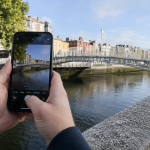
Looking for an easy smartphone photography tip?
You don’t need an expensive camera or complicated editing software to take more interesting photographs.
In fact, one of the simplest smartphone photography tips is to look for something that is already around you: reflections.
Water, windows, mirrors, puddles and even shiny surfaces can completely change the way you photograph an ordinary scene. Once you start looking for reflections, you’ll begin seeing potential photographs everywhere.
Why reflections work so well in photography
A reflection gives you a second version of your subject within the same photograph.
Instead of simply photographing a building, for example, you might photograph the building and its reflection in a puddle. This can create symmetry, interesting shapes and a much stronger sense of depth.
Reflections can also make familiar locations look completely different.
A street that you’ve walked down hundreds of times might suddenly become an interesting photograph after rainfall. A puddle on the pavement can turn the sky, buildings and people around you into a completely different composition.
That’s particularly useful when you’re exploring a city with your smartphone.
Get lower than you normally would
Here’s the important part of this smartphone photography tip.
When you find a reflection, don’t just stand up and take the photograph from eye level.
Lower your phone.
Try holding your smartphone just a few centimetres above the surface of the water. As you move closer to the ground, the reflection will take up much more of your photograph.
You might even crouch down or kneel if the location allows it.
This simple change in height can turn a fairly ordinary photograph into something much more dramatic.
Try flipping your photograph
Here’s another fun experiment.
Take your reflection photograph normally and then turn your phone upside down while looking at the image.
Suddenly, the reflected world can become the main subject.
This can work particularly well with:
- Historic buildings
- Bridges
- Street scenes
- City skylines
- Trees
- Coastal landscapes
- Colourful buildings
- People walking through a scene
The viewer may have to look twice to work out which part of the image is the real scene and which part is the reflection.
Look for reflections beyond puddles
Puddles aren’t the only way to use this technique.
When you’re taking photographs with your smartphone, start looking for reflective surfaces wherever you go.
Windows
Shop windows can create fascinating photographs because they combine the reflection of the street with whatever is inside the building.
Try photographing someone walking past a shop window and see how the two scenes interact.
Water
Rivers, lakes and the sea can provide much larger reflections.
On a calm day, buildings, mountains, boats and trees can be reflected almost perfectly.
Glass
Modern buildings often have large glass surfaces that can reflect surrounding architecture.
Instead of photographing the building itself, try photographing the reflection of another building in its windows.
Mirrors
If you’re indoors, mirrors can provide another opportunity to experiment.
Rather than simply photographing yourself, think about what else you can include in the reflection.
Don’t worry about perfect symmetry
It’s tempting to try to make your reflection photograph perfectly symmetrical.
But it doesn’t always have to be.
Sometimes the most interesting photographs are created when the real scene occupies one part of the image while the reflection fills another.
You could have a person walking through the real scene while their reflection appears below them.
Or you could photograph a building where only part of its reflection is visible in a puddle.
Experiment rather than trying to make everything perfect.
Use your smartphone’s grid
If you’re struggling to compose your reflection photograph, turn on the camera grid on your smartphone.
The grid can help you position the horizon or the dividing line between the real scene and its reflection.
You could try placing the horizon roughly in the middle of the image for a symmetrical composition.
Alternatively, place it higher or lower to give either the real scene or the reflection more space.
There isn’t one correct answer — take several versions and see which composition works best.
An easy photography challenge
Next time you’re out with your smartphone, give yourself a simple challenge:
Find three reflections in 10 minutes.
Don’t worry about finding famous landmarks.
Look for:
- A puddle
- A window
- A body of water
Photograph each one from several different heights and angles.
You’ll probably find that moving just a few steps or lowering your phone can completely change the photograph.
That’s one of the great things about smartphone photography. You don’t necessarily need better equipment.
Sometimes you just need to look at an ordinary scene differently.
Try this on your next PicTour
At PicTours, we encourage students and visitors to experiment with their smartphones and find creative ways of photographing the places around them.
Using reflections is a perfect example.
Whether you’re exploring Dublin, Cork, Galway, Sligo, Edinburgh, Birmingham or Manchester, keep an eye out for puddles, windows and water.
You might be surprised by how many photographic opportunities are hiding in plain sight.
And remember: before pressing the shutter, change your position.
Get lower. Move sideways. Look behind you. Check the reflection.
Your smartphone might be capable of a much more interesting photograph than you think.
Final tip
The next time it rains, don’t automatically put your phone away.
Look down.
That puddle at your feet might just be your best photograph of the day.
Looking to improve your smartphone photography? Join a PicTour and discover your city through your camera phone.